



AI-enabled irrigation systems are reducing water use on farms by as much as 55% in West and Central Africa.
At the edge of a sun-drenched farm, a young entrepreneur watches his solar-powered pump come quietly to life. Not because someone flipped a switch, but because a system he built decided the moment was right. The soil was dry enough. The sun was strong enough. The crops were ready.
This is not a distant agricultural future. It is happening now. Born out of a clean energy agritech innovation challenge for young entrepreneurs across West Africa, the system processes real-time data on soil moisture, weather forecasts and solar energy supply. It automatically switches irrigation on or off and matches water delivery to exactly what crops need. On a one-hectare pilot farm, a 2.5 Horsepower (HP) pump powered by 3.5 kilowatt (kW) of solar panels delivers up to 70 cubic meters of water daily through nearly 7,000 meters of drip lines. The system is synced to solar irradiance to prevent both over-extraction and energy loss. It does not just irrigate, it thinks, adapts and conserves.
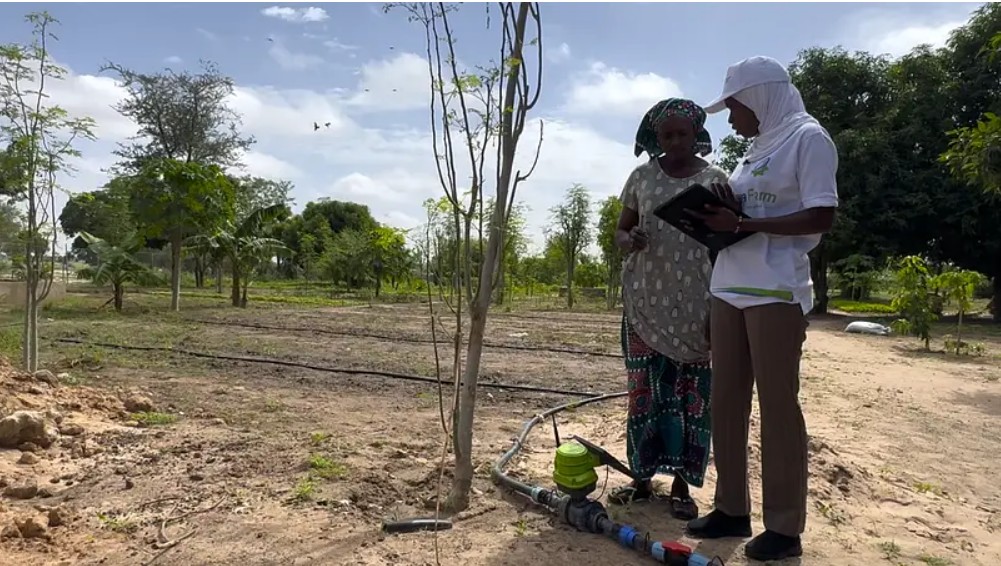
An innovator explains an AI-enabled irrigation application on a tablet. Powered by an off-grid solar energy system, the technology helps farmers optimise water and energy use. Photo: Ferdinand Tornyie/UPSA
Across West and Central Africa, climate change is making rain-fed agriculture increasingly unreliable. Droughts are intensifying, rainfall is shifting, and yield losses of 10% to 20% in staple crops such as maize, millet and sorghum are becoming routine. Most smallholder farmers still rely on costly diesel pumps and water-intensive practices that drive up production costs and environmental pressure. These converging pressures create a water-energy challenge but also an opening for innovation. Young African innovators, supported through a dedicated innovation challenge, are applying artificial intelligence (AI) to develop smarter, solar-powered irrigation systems.
What does this innovation achieve?
The outcomes of these agritech innovations are measurable. Water use drops by 35% to 55% compared to conventional methods. Crops receive water at the right time and quantity, reducing the risk of poor yields. Lower water and energy use cut production costs, while better yields support higher, more stable incomes. Together, these gains improve livelihoods and strengthen farmers’ resilience to climate shocks. The International Water Management Institute (IWMI) is supporting this trajectory by advancing digital water tools, remote sensing and climate-smart irrigation research to translate youth-led innovations into wider practice across Africa.
How and where is the innovation applied?
The pilot AI-enabled irrigation control system is proving its relevance where it matters most in a region defined by high climate vulnerability, growing digital adoption and expanding solar energy markets. The innovation challenge paired competition with mentorship and funding to produce a practical, deployable prototype.
The AI-enable Agritech system operates at farm level, connecting directly to solar-powered irrigation hardware and allowing remote monitoring by the farmers. With Africa’s AI economy projected to grow from $4.5 billion in 2025 to over $16.5 billion by 2030, conditions for scaling this innovation are improving rapidly.
Sprinklers irrigate a field as a farmer and youth innovator walk through it. The irrigation system is managed through an AI-enabled mobile application powered by off-grid solar energy. Photo: Ferdinand Tornyie/UPSA
What is holding this innovation back?
Scaling AI-driven irrigation faces several barriers. Connectivity is the first constraint. Thirteen percent of sub-Saharan Africans lives beyond mobile broadband coverage, while a 60% usage gap leaves most of those under coverage offline — limiting the real-time data transmission these systems depend on. Energy access is another. Nearly 600 million people across the region still lack electricity, and while solar offers the most viable off-grid alternative, the high upfront cost of hardware places it beyond the reach of most smallholder farmers. Skill gaps compound these constraints, where few universities offer practical training in machine learning, geospatial analytics or digital agriculture. Women also remain underrepresented across digital agriculture ecosystems. Above all, most youth-led innovations never move beyond the pilot stage, not for lack of ideas, but for lack of affordable capital to scale.
AI infrastructure itself requires energy, a real concern where power systems are weak. Closing these gaps requires coordinated investment in renewable energy, digital connectivity, inclusive skills development and innovation financing — including innovation challenges and scale-up funds that actively target women-led agritech ventures. IWMI’s research and partnerships are helping connect technology to policy, and pilots to practice.
Scaling youth-led AI innovation.
The AI-driven irrigation system developed through the youth clean energy agritech innovation challenge shows that practical solutions to the water-energy challenge are already within reach. Youth innovators in West and Central Africa are building them and the results show that AI-powered irrigation can deliver real gains in water and energy efficiency, crop productivity and farmer income.
Moving from pilot to practice requires two things. First, institutions including universities, startup hubs, government agencies, financial institutions and organisations such as IWMI must invest in the skills, infrastructure and financing that enable youth innovators to scale. Second, digital agriculture and AI-driven irrigation must be embedded in national agricultural strategies across the region.
Source: https://tinyurl.com/t5s7pjy