




Key Highlights
- IIT Roorkee develops a new spring in Unchaun village, Tehri Garhwal, Uttarakhand.
- Lean-season drinking-water availability rises from approximately 500 litres to 1,000 litres or more per day.
- Two research studies identify the role of monsoon rainfall, groundwater storage and geological formations in spring recharge.
- The project is funded by Namami Gange under the National Mission for Clean Ganga, Ministry of Jal Shakti.
IIT Roorkee Develops New Spring to Address Himalayan Water Scarcity
The Indian Institute of Technology Roorkee (IIT Roorkee) has developed a new spring in Unchaun village in Uttarakhand’s Tehri Garhwal district, demonstrating how scientific research can be translated into practical solutions for rural water security.
The intervention has reportedly increased lean-season drinking-water availability from approximately 500 litres to 1,000 litres or more per day, providing relief to households dependent on local water sources, particularly during the summer months.
The initiative is part of the project titled “Rejuvenation of Drying Springs in Takoli Gad Catchment of Tehri District, Uttarakhand”, funded by Namami Gange, National Mission for Clean Ganga, Ministry of Jal Shakti, Government of India.
IIT Roorkee is the lead institute, with Prof. Abhayanand Singh Maurya of the Department of Earth Sciences serving as Principal Investigator.
Two Research Studies Explain Himalayan Spring Recharge
The intervention draws on two research studies conducted in the approximately 143-square-kilometre Takoli Gad watershed in the Lesser Himalaya, within the Alaknanda River basin.
The first study, published online in the Hydrological Sciences Journal on October 12, 2026, used stable isotopes, tritium measurements and hydro-meteorological data to investigate spring-recharge dynamics.
The research estimated that approximately 82% of spring-water recharge comes from monsoon precipitation. Winter and pre-monsoon precipitation contribute around 10% and 8%, respectively. The findings underline the importance of monsoon infiltration and groundwater storage in sustaining springs throughout the year.
The second study, published in Applied Geochemistry in 2026, examined the influence of geological formations and seasonal weathering on spring-water chemistry. It identified carbonate weathering, seasonal recharge and anthropogenic activity as important factors influencing water quality.
Together, the studies provide insights into both the replenishment and chemical characteristics of Himalayan springs, supporting more scientific and location-specific spring-shed management.
Scientific Intervention Uses Geophysical Surveys and Recharge Trenches
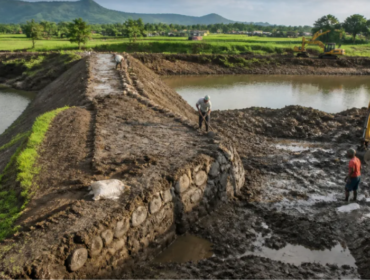
Geophysical investigations helped the IIT Roorkee team identify water-bearing rock layers capable of storing and releasing groundwater. Based on the findings, researchers estimated the depth and extent of these zones and designed a series of trenches along the uphill slope.
The trenches slow surface-water movement and allow more rainfall to infiltrate into the subsurface, supporting groundwater recharge.
At the identified water-bearing zone, the team created a controlled opening to bring groundwater to the surface, thereby developing a new spring.
The spring has been developed in Unchaun village, Post Office Takoli, Kirtinagar Block, Tehri Garhwal district, along the newly constructed road leading to Chandrabadni Temple.
Research Offers a Model for Himalayan Water Security
Himalayan springs are essential freshwater sources for mountain communities, particularly in remote settlements with limited alternatives. However, nearly 50% of springs are reportedly either permanently dried up or experiencing severely reduced discharge, especially during summer.
The Unchaun intervention demonstrates the potential of combining hydrogeological assessment, understanding of groundwater recharge pathways and locally appropriate engineering solutions to address seasonal water shortages.
Continued monitoring of spring discharge and water quality, along with community participation, will be important to assess the intervention’s long-term performance and guide similar initiatives in other Himalayan settlements.
IIT Roorkee Leadership Highlights Research with Community Impact
Prof. Abhayanand Singh Maurya said that understanding the source, movement and seasonal behaviour of spring water is essential to addressing water scarcity in the Himalayan region. He noted that research on monsoon recharge, groundwater storage and geological conditions can guide site-specific interventions and sustainable spring management.
IIT Roorkee Director Prof. K. K. Pant emphasised the importance of connecting scientific research with community needs. He said the institute aims to translate scientific evidence into practical, locally relevant solutions for water security and sustainable resource management.
IIT Roorkee’s intervention in Unchaun village demonstrates how scientific research can help address persistent water challenges in the Himalayan region. By combining geological investigations, groundwater-recharge measures and field-level implementation, the initiative offers a promising approach to improving rural drinking-water availability and strengthening spring-shed management.
Source: https://tinyurl.com/yedd9ymf