



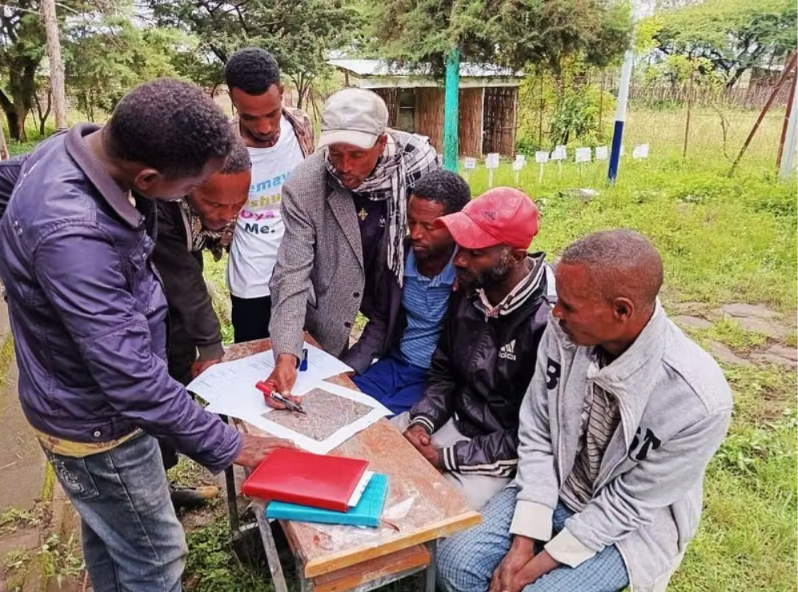
Locally generated evidence gives communities a stronger role in understanding and managing their water resources.
‘My engagement in the citizen science initiative helped produce environmental information while also strengthening my ownership of natural resources management and experience sharing about the initiative.
Tsegaye Alemu, para-hydrologist, Chemeri watershed, Limu Bilbilo district, Oromia region.’
For Tsegaye Alemu, participating in citizen science was about more than just measuring water. His work helped generate information about the environment around him but also changed his relationship with the natural resources that sustained his community. This gave him a stronger sense of responsibility for their management and an opportunity to share what he learned with others.
Alemu’s experience illustrates a broader change taking place in Ethiopia. Local communities are increasingly moving from being just recipients of research or sources of information to becoming active participants in generating evidence, interpreting it and helping shape decisions about their landscapes.
This mindset shift matters in watersheds, where environmental conditions can vary significantly across both space and time. Local communities are often best placed to observe these changes, while scientific expertise can help turn those observations into evidence that informs management.
Local knowledge meets scientific evidence
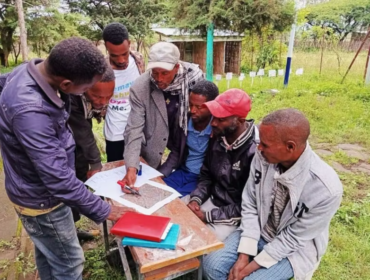
Citizen science is bringing professional researchers and community volunteers together to generate and use knowledge. Communities can help define research questions, collect data, map landscapes, interpret findings and identify practical management options.
The International Water Management Institute (IWMI) has applied citizen science in Ethiopia for about 12 years, building experience using community participation to understand watershed conditions and the hydrological benefits of landscape management. More recently, this work has advanced through the Nature-based Solutions for Sustainable and Inclusive Development (NSSID) program, implemented by IWMI, Farm Africa and other partners.
IWMI trained 40 government and non-governmental organisation experts and 26 community representatives over a two-year period and supported them to develop a practical framework for establishing citizen science initiatives that can be adapted to local conditions. Trainees received hands-on training on monitoring equipment, data recording sheet, monitoring time and frequency, and feedback provision mechanisms.
Shaped iteratively with citizen scientists and partners, the IWMI citizen science framework is a practical and customisable three-stage approach that includes processes of establishment, operations and knowledge co-generation for hydrological monitoring to support nature-based solutions.
This approach was tested in the Chemeri watershed in Limu Bilbilo district, Oromia region, and the Kelekindo watershed in South Sodo district, Central Ethiopia region. Citizen scientists monitored river and shallow groundwater levels, rainfall and water quality in the two watersheds. In Kelekindo, they collected additional water quality data, helped in community mapping and identifying potential watershed intervention sites and contributed to interpreting the information generated.
The result was critical to nature-based solutions and the implementation of the framework demonstrated measurable success in data collection, maintaining 78% retention rate of citizen scientists over several months — exceeding the 60%–70% typically reported for citizen science programs worldwide.
Yirgalem Teshale, a para-hydrologist from Kelekindo watershed, said involvement in the citizen science program went beyond gaining new expertise on watershed and environmental data collection. “I learned multi-stakeholder communication skills and the ability to coordinate and disseminate watershed data to community members, citizen scientists, district administration and researchers,” Teshale said. The experience showed that community participation can expand the reach of environmental monitoring while making research more closely connected to local realities.
From local experience to national systems
The longer-term opportunity lies in taking these lessons beyond individual watersheds. Ethiopia’s Ministry of Water and Energy has incorporated citizen science into the draft National Water Policy and Basin Monitoring Strategy, and is piloting the approach through a water quality monitoring initiative in Lake Hawassa in Sidama region.
Yirgalem Esuneh, Head of the Eco-Hydrology and Water Quality Desk at the ministry said bringing citizen science into national policies and programs can help connect science, policy and community stewardship in managing water resources. IWMI and its partners continue to advocate for citizen science within national programs, digital platforms and water and basin monitoring systems.
The experience in the Chemeri and Kelekindo watersheds suggests that the value of citizen science is not simply in producing more data. It lies in building a stronger connection between evidence, local knowledge and ownership. When people actively generate the information used to understand their watersheds, they are better positioned to shape the decisions that affect their future.
Source: https://tinyurl.com/yfbmdjy7