


Chinese authorities have consistently rejected suggestions that the project poses risks to downstream countries.
China has begun building the world’s largest hydropower project on the Yarlung Tsangpo river — the same river that becomes the Brahmaputra once it crosses into Arunachal Pradesh — reviving a question New Delhi has wrestled with for over a decade: can Beijing, sitting upstream, actually control how much water reaches India?
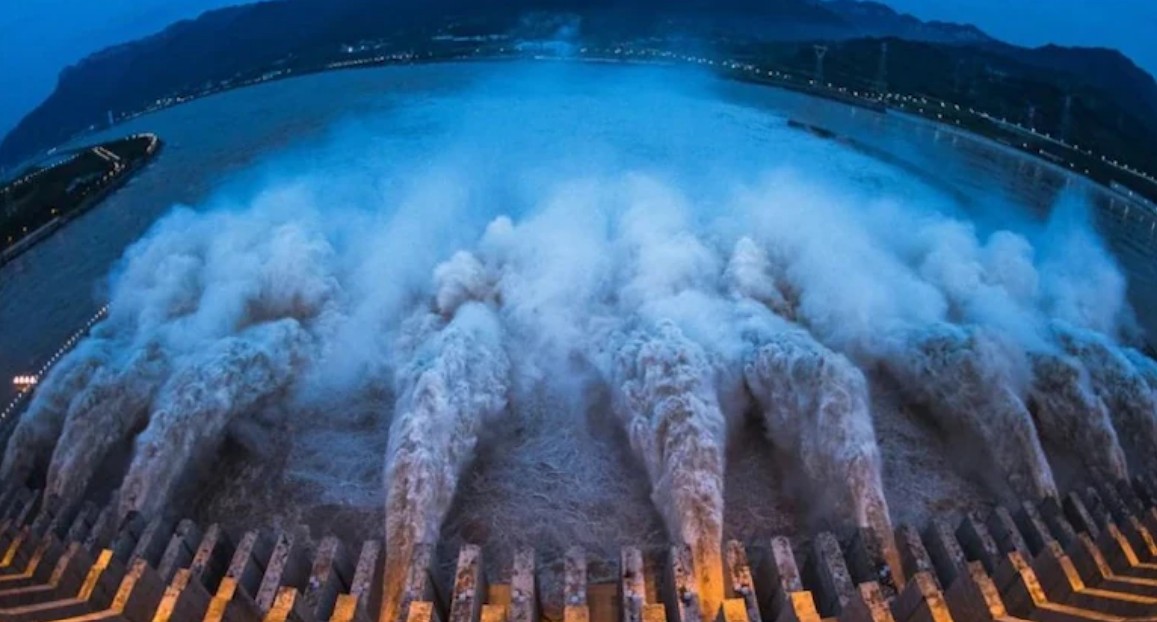
The numbers alone explain the alarm. The project, centered on the river’s dramatic “Great Bend” near Medog in Tibet, is designed around five cascade power stations with a combined capacity estimated at over 60 gigawatts — nearly triple the Three Gorges Dam, currently the world’s largest hydropower station and expected to generate more than 300 billion kWh of electricity annually.
The total investment is pegged at 1.2 trillion yuan (roughly $167 billion), making it the world’s biggest infrastructure project.
Over a stretch of just 30 miles, the river drops nearly 6,500 feet — one of the steepest descents of any major river on Earth. China plans to divert the river through multiple tunnels, some longer than 12 miles, to feed the cascade of power stations rather than storing water behind a single dam wall.
According to the South China Morning Post (SCMP), Chinese Premier Li Qiang described the hydropower project as the “project of the century” while inaugurating construction.
The Indian fear: An 85% flow cut
As per sources reuters reported in August 2025 that Indian government analysis had flagged the possibility of dry-season flows on the river falling by as much as 85%, citing sources familiar with the matter.
However, Chinese authorities have consistently rejected suggestions that the project poses risks to downstream countries. Chinese Foreign Ministry spokesperson Mao Ning said the project had undergone decades of scientific studies and environmental assessments. According to SCMP, she said China would continue maintaining communication with downstream countries while strengthening cooperation on disaster prevention and mitigation.
Meanwhile, according to a report by The Times of India, hydrologists say China cannot permanently stop the Brahmaputra from flowing into India because the river receives substantial additional water from heavy monsoon rainfall and numerous tributaries after entering Arunachal Pradesh and Assam. However, according to experts, as cited by TOI, a massive upstream reservoir would enable China to regulate the timing and volume of water releases to a certain extent.
Furthermore, experts also distinguish between water diversion and flow regulation. China’s project has been described as a hydropower dam rather than a diversion scheme. Run-of-the-river hydropower projects generally release water downstream after generating electricity, although reservoirs can alter seasonal flows and the timing of releases.
Why is India concerned?
According to South China Morning Post (SCMP), New Delhi increasingly views the project through the prism of national security because the river flows through Arunachal Pradesh, which China claims as “South Tibet.”
Arunachal Pradesh Chief Minister Pema Khandu recently described the project as a potential “water bomb”, warning that river flows could “dry up considerably” while the reservoir is being filled and that sudden releases could increase flood risks downstream, according to SCMP.
There is also an absence of comprehensive water-sharing treaty governing the Brahmaputra between India and China.
Geologists warn of active fault
A study by Chinese geologists has raised fresh concerns over the safety of China’s massive hydropower project on the Brahmaputra River, identifying an active fault line beneath the construction site in Tibet that could undermine the stability of the dam and related infrastructure.
The findings contrast with Beijing’s longstanding assertions that the project has been designed to the highest safety standards and would help reduce disaster risks in the region.
According to a report by the South China Morning Post, the researchers found that the Paizhen Fault in eastern Tibet remains geologically active and poses a significant risk to the structural integrity of the hydropower station and associated infrastructure.
India’s countermove
India has fast-tracked its own answer: It is pushing forward with the Siang Upper Multipurpose Project (SUMP), an 11,000 MW hydroelectric and flood-control mega-dam proposed on the Siang river in Arunachal Pradesh’s Upper Siang and Siang districts.
Driven by state-run NHPC, SUMP would become India’s largest hydropower project if built, generating an estimated 47 billion units of electricity annually at a projected cost of approximately US$13 billion (roughly Rs 1.5 lakh crore).
Source: https://tinyurl.com/7xk5tdyh