

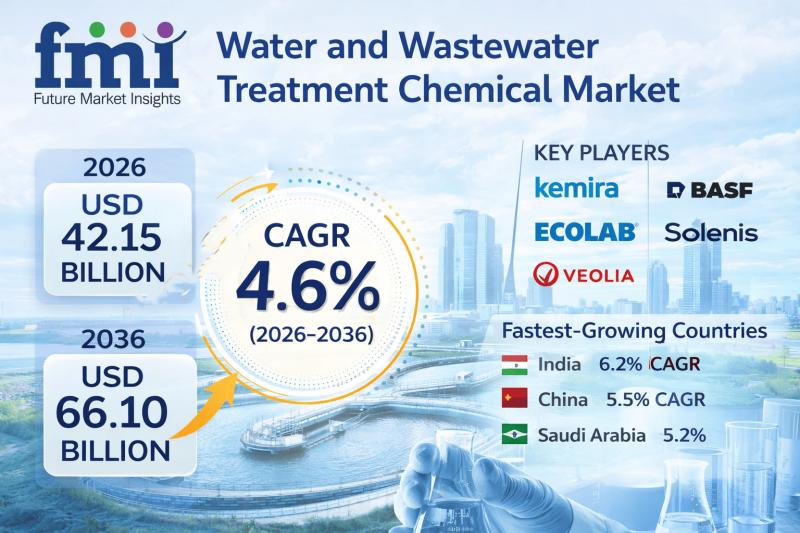
The global Water and Waste Water Treatment Chemical Market is entering a decade of compliance-driven transformation. Valued at USD 40.30 billion in 2025, the market is projected to reach USD 42.15 billion in 2026 and expand further to USD 66.10 billion by 2036. According to analysis by Future Market Insights (FMI), the sector is forecast to grow at a CAGR of 4.60% during 2026-2036.
Growth is anchored in tightening global regulatory mandates targeting PFAS, nutrient discharge, and industrial effluents. Federal and regional infrastructure programs are compelling utilities and industries to modernise water treatment systems, accelerating demand for high-performance specialty chemicals across municipal and industrial cycles.
Water and Waste Water Treatment Chemical Market Snapshot (2026-2036)
Market size in 2026: USD 42.15 billion
Market size in 2036: USD 66.10 billion
CAGR (2026-2036): ~4.60%
Leading product segment: Coagulants & Flocculants (40.4% share)
Leading application segment: Raw Water Treatment (35.0% share)
Dominant end-user: Municipal (45.0% share)
Fastest-growing countries: India (6.2%), China (5.5%), Saudi Arabia (5.2%)
Market Momentum
Between 2026 and 2030, expansion will be primarily compliance-led. The implementation of stricter drinking water standards and industrial discharge limits is driving retrofit investments in advanced dosing systems and specialty reagents. Regulatory action against emerging contaminants such as PFAS is shifting procurement from generic chemical solutions toward premium formulations capable of micropollutant removal.
From 2031 to 2036, market growth will be reinforced by Zero Liquid Discharge (ZLD) adoption, desalination expansion, and circular water economy models. Industries such as semiconductors, power generation, and mining will increasingly invest in closed-loop water reuse systems, intensifying demand for advanced coagulants, antiscalants, corrosion inhibitors, and biocides.
or
Why the Market is Growing
The Water and Waste Water Treatment Chemical Market is expanding due to three structural forces:
Regulatory Enforcement:
Stringent EPA and EU regulations targeting PFAS and nutrient discharge are mandating immediate upgrades to treatment protocols. Utilities must adopt advanced chemical regimes capable of meeting legally binding contaminant thresholds.
Infrastructure Modernisation:
Aging municipal infrastructure across North America and Europe is undergoing modernisation. Infrastructure funding programs are unlocking procurement cycles for upgraded treatment chemistries.
Industrial Water Reuse & ZLD:
Industrial operators are shifting toward water reuse strategies to mitigate water scarcity and ESG risks. ZLD systems require specialised conditioning chemicals to maintain membrane performance and prevent scaling.
Segment Spotlight
Product Type: Coagulants & Flocculants Lead Demand
Coagulants and flocculants account for approximately 40.4% of total market share in 2026. These agents remain indispensable for solid-liquid separation in municipal and industrial facilities. Advanced polymer formulations that improve sludge dewatering efficiency are gaining traction, reducing operational and transport costs for utilities.
Application: Raw Water Treatment Dominates
Raw Water Treatment holds approximately 35.0% market share, driven by rising turbidity and contamination levels in freshwater sources. Utilities must intensify pretreatment chemical dosing to protect downstream filtration infrastructure.
End User: Municipal Segment Anchors Stability
Municipal entities account for roughly 45.0% of demand, providing long-term baseline volume stability. Industrial end users-including power generation, oil & gas, mining, and manufacturing-contribute high-value specialty chemical demand driven by compliance liability and operational continuity.
Drivers, Opportunities, Trends, Challenges
Drivers:
• Enforcement of PFAS and nutrient discharge standards
• Infrastructure funding programs
• Expansion of desalination and ZLD systems
Opportunities:
• PFAS destruction technologies
• Renewable-powered chemical production
• Brine mineralisation solutions in desalination
Trends:
• Shift toward bio-based and low-carbon formulations
• Integration of digital monitoring and dosing optimisation
• Localisation of production in high-growth Asian markets
Challenges:
• High capital costs for plant retrofits
• Volatility in raw material feedstocks
• Budget constraints in emerging municipalities
Country Growth Outlook (2026-2036)
India leads expansion at 6.2% CAGR, supported by industrialisation and infrastructure development. China follows at 5.5%, driven by industrial discharge compliance and localised chemical manufacturing expansion. Saudi Arabia grows at 5.2% due to desalination capacity growth aligned with national water security initiatives.
The United States advances at 4.2%, driven by federal PFAS mandates and infrastructure grants. Germany (3.8%) and Brazil (4.9%) focus on circular water economy and industrial water efficiency improvements.
Competitive Landscape
The Water and Waste Water Treatment Chemical Market is moderately consolidated, with global leaders integrating specialty portfolios and service capabilities.
Key players include:
• Kemira
• BASF
• Ecolab
• Veolia
Competition is shifting toward value-added service contracts, digital monitoring integration, and localised production strategies. Companies investing in renewable-powered manufacturing and PFAS-destruction technologies are positioned to capture premium contracts over the forecast period.
Frequently Asked Questions (FAQ)
What is the global market size?
The market is projected to reach USD 42.15 billion in 2026 and USD 66.10 billion by 2036.
What is the expected growth rate?
The market is forecast to grow at a CAGR of approximately 4.60% from 2026 to 2036.
Which segment dominates?
Coagulants & Flocculants lead with 40.4% market share in 2026.
What is driving premium product growth?
Regulatory enforcement targeting PFAS, infrastructure modernisation, and industrial water reuse initiatives are accelerating demand for high-performance specialty chemicals.
Source: https://tinyurl.com/hdutc7sd