

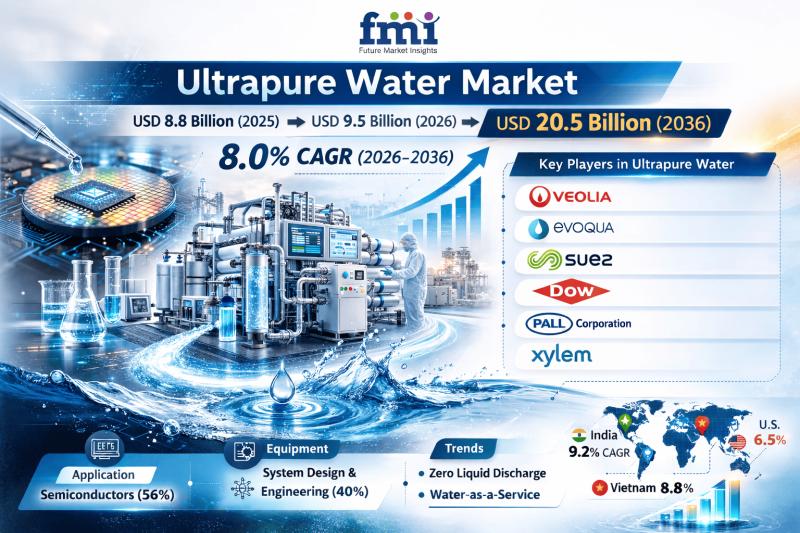
The global Ultrapure Water (UPW) market registered a valuation of USD 8.8 billion in 2025 and is projected to reach USD 9.5 billion in 2026. According to analysis by Future Market Insights (FMI), the market is forecast to expand to USD 20.5 billion by 2036, registering a robust CAGR of 8.0% during the 2026-2036 period.
Growth reflects the rapid densification of semiconductor fabrication nodes, where microscopic contaminants can destroy wafer yields. Procurement benchmarks are shifting from standard purity metrics to node-critical specifications defined by global industry bodies. The December 2024 revision of the SEMI F63-1224 standard introduced more stringent parameters for UPW in sub-32 nm processing, accelerating retirement of legacy filtration infrastructure.
Ultrapure Water Market Snapshot (2026-2036)
Market size in 2026: USD 9.5 billion
Market size in 2036: USD 20.5 billion
CAGR (2026-2036): ~8.0%
Leading application segment: Semiconductors (56% of total volume)
Top equipment segment: System Design & Engineering (40% share)
Fastest-growing country: India (9.2% CAGR)
Competitive landscape: Integrated water technology leaders and specialised purification innovators
Market Momentum
Between 2026 and 2030, expansion will be driven by aggressive semiconductor fab construction across Asia and North America. A single advanced fabrication facility consumes millions of gallons of UPW daily, creating structurally inelastic demand insulated from short-term macro volatility.
From 2031 to 2036, the market will evolve toward performance-guaranteed, “water-as-a-service” models. Integrators will assume operational risk to guarantee resistivity levels below 0.055 μS/cm, shifting competitive advantage from component sales to full-lifecycle system management.
Why the Market is Growing
The Ultrapure Water Market is expanding due to three primary forces:
Semiconductor Capacity Expansion:
National supply-chain resilience programs are funding domestic fabrication ecosystems. Semiconductor manufacturing accounts for 56% of UPW consumption, driven by strict yield-protection requirements.
Regulatory Tightening:
Environmental mandates increasingly require high recovery rates and wastewater minimisation. Facilities must integrate advanced recycling and contaminant destruction technologies to maintain compliance.
Pharmaceutical and Life Sciences Precision:
Pharmaceutical manufacturing demands sterile, contaminant-free water to meet global safety standards. Regulatory audits are reinforcing investment in validated purification systems.
Rather than competing purely on filtration hardware, providers are shifting toward integrated performance contracts emphasising contaminant removal precision, system uptime, and energy efficiency.
Segment Spotlight
Application: Semiconductors Lead Demand
Semiconductors command 56% of total market volume in 2026. Node miniaturisation requires elimination of nano-scale particles and ionic species once considered tolerable. The transition to sub-32nm geometries has redefined procurement thresholds and increased capital intensity for UPW infrastructure.
Equipment: System Design & Engineering Dominates
System Design & Engineering represents approximately 40% of market value, reflecting the complexity of integrating reverse osmosis, ion exchange, membrane filtration, and distillation layers into cohesive plants. Buyers increasingly demand turnkey solutions with long-term performance guarantees rather than piecemeal equipment procurement.
Drivers, Opportunities, Trends, Challenges
Drivers:
Semiconductor fab expansion and reshoring initiatives
Stringent environmental compliance requirements
Growth in pharmaceutical and advanced manufacturing
Opportunities:
Boron-selective resins for sub-32nm processing
PFAS destruction integration
Modular, containerised UPW systems for emerging markets
Trends:
Water-as-a-service contractual models
Integration with desalination in water-scarce regions
Increased adoption of zero liquid discharge systems
Challenges:
Rising energy costs impacting operational expenditure
Capital intensity of high-recovery installations
Complex regulatory harmonisation across regions
Country Growth Outlook (2026-2036)
India leads global growth at a projected 9.2% CAGR, supported by semiconductor mission investments and supply chain localisation. Vietnam follows at 8.8%, driven by advanced manufacturing relocation.
Saudi Arabia (8.6%) and Singapore (8.4%) benefit from integrated desalination and recycling mandates, while China records 7.9% CAGR tied to domestic fab construction. The United States maintains steady 6.5% growth driven by retrofit modernisation and PFAS compliance initiatives.
Competitive Landscape
The Ultrapure Water Market is undergoing strategic consolidation as global players seek control over full purification ecosystems.
Key companies include:
Veolia
Evoqua
Suez
Dow
Pall Corporation
Xylem
DuPont
Kurita Water Industries Ltd
Market leaders are differentiating through proprietary resin chemistry, advanced oxidation systems, and PFAS-elimination capabilities.
Frequently Asked Questions (FAQ)
What is the global Ultrapure Water Market size?
The market is projected to reach USD 9.5 billion in 2026 and USD 20.5 billion by 2036.
What is the expected growth rate?
The market is forecast to grow at a CAGR of approximately 8.0% from 2026 to 2036.
What defines ultrapure water?
Ultrapure water is treated to conductivity levels below 0.055 μS/cm, removing organic, inorganic, and particulate contaminants for high-precision industrial use.
What is driving premium system adoption?
Node miniaturisation, environmental mandates, and lifecycle risk transfer through service-based contracts are accelerating demand for integrated, performance-guaranteed UPW solutions.
Source: https://tinyurl.com/er34wx47