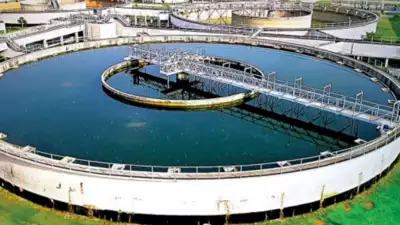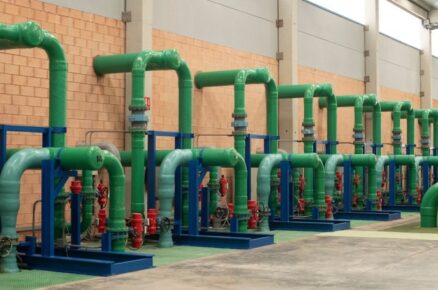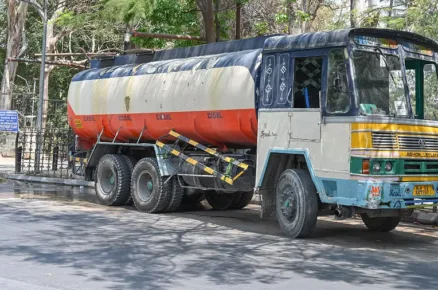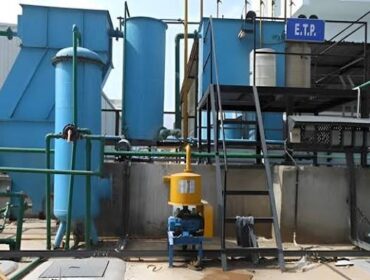



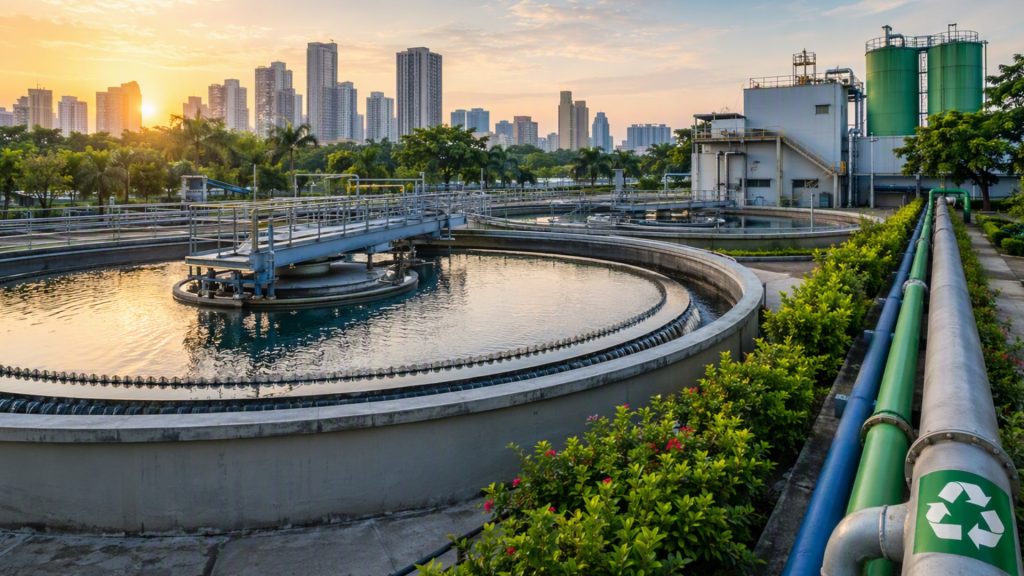
India generates approximately 112 billion liters per day (BLD) of wastewater, making it one of the largest producers globally. However, only about 28% of this wastewater is treated, with an even smaller share, around 8% being reused.
According to the Economic Survey 2025–26, India is now the world’s third-largest producer of wastewater, underscoring the increasing urgency for large-scale treatment and reuse infrastructure.
Operational data highlights deeper inefficiencies:
- Installed capacity: ~31.8 BLD
- Operational capacity: ~26.8 BLD
- Utilised capacity: ~20.2 BLD
Urban India generates over 52.0 BLD of wastewater. The next phase of value creation will depend less on capacity addition and more on improving utilisation, operational efficiency, and asset performance.
Infrastructure Expansion Driven by Policy Initiatives
The sector has witnessed significant growth driven by government programs:
- AMRUT/AMRUT 2.0 – Urban water supply and sewerage infrastructure
- Swachh Bharat Mission (Urban & Grameen) – Sanitation and wastewater management
- Namami Gange Programme – River rejuvenation through STP development
- Jal Jeevan Mission – Water supply expansion, with indirect wastewater implications
These initiatives led to:
- Increase in number of STPs from ~746 (2014) to ~1,469 (2020)
- Significant expansion in sewer networks and urban coverage
- Increased focus on river rejuvenation
Such policies have begun to actively mandate wastewater reuse, shifting it from an optional practice to a regulatory requirement. For instance, Uttar Pradesh, India’s most populous state, has set ambitious targets of achieving 50% reuse by 2030 and scaling up to 100% reuse by 2035. Additionally, Maharashtra approved a policy to promote a circular economy by processing and reusing sewage and wastewater across 424 urban local bodies. Several other metropolitan cities including Chennai, Bengaluru, Hyderabad, and Surat have already begun supplying treated wastewater to industries, reducing dependence on freshwater resources while creating new revenue streams for utilities.
India has successfully transitioned from policy intent to infrastructure deployment. The next wave of returns will depend on lifecycle performance, operating efficiency, and the ability to convert treated wastewater into a monetisable resource.
Structural Challenges in the Sector
Despite infrastructure expansion, systemic challenges persist:
- Underutilisation of Assets: Only approximately75% of operational capacity is utilised, driven by inadequate sewer connectivity and inflow variability.
- Limited Sewerage Coverage: Less than 27% of households are connected to sewer networks, limiting the ability to fully load treatment plants.
- Regional Imbalance: The majority of treatment capacity is concentrated in a few states
- Institutional and Financial Constraints: Weak municipal capabilities, Delays in O&M payments & land and approval bottlenecks.
- Low-Cost Recovery: User charges for wastewater services remain insufficient in many municipalities, constraining long-term O&M expenditure and limiting the financial sustainability of utilities
Underutilised assets weaken returns on invested capital, making O&M efficiency, annuity-based models, and performance-linked contracts critical to sector sustainability.
Emerging Growth Themes and Sector Transformation:
The wastewater sector in India is undergoing a structural transformation:
- Wastewater as a Future Industrial Water Backbone: Future non-potable demand from industry, power, and construction will increasingly be met through treated wastewater, positioning it as a parallel industrial water grid.
- Shift from Capex to O&M Focus: Growing emphasis on long-term performance and plant efficiency, alongside increasing adoption of the Hybrid Annuity Model (HAM).
- Increasing Focus on Water Reuse: Industrial and non-potable reuse is gaining importance but remains significantly underpenetrated at approximately8%.
- Rise of Decentralised Treatment Systems: Growing adoption in smaller cities and peri-urban areas.
- Technology Integration: SCADA systems, IoT-enabled flow and quality monitoring, predictive maintenance, and automation are improving uptime, compliance, and operating efficiency.
- Energy and Resource Recovery: Modern STPs are increasingly being designed to recover biogas, generate renewable energy, recover nutrients, and reduce overall lifecycle operating costs, supporting India’s transition toward a circular economy.
The sector is evolving toward performance optimisation and circular water use. Technology adoption is directly improving plant uptime, efficiency, and compliance, addressing the sector’s biggest bottlenecks.
Future Growth Imperatives OR Strategic Growth Priorities
India’s wastewater generation is projected to increase by nearly 75–80% by 2050, driven by urbanisation and industrialisation. Strong growth opportunities are emerging across:
- Water reuse markets
- Industrial wastewater treatment
- Decentralised systems
- Long-term O&M and PPP models
India’s wastewater sector is expected to evolve into a circular water economy in which treated wastewater becomes a critical secondary resource.
India’s wastewater challenge is no longer limited to treatment capacity; the larger opportunity lies in monetising treated water and improving asset utilisation. The next decade of sector growth will be shaped by how effectively stakeholders convert treatment infrastructure into resilient, revenue-generating circular water systems.
Source: https://tinyurl.com/4c6k8yem