



The Case of aGuadalajara
By Mirna Aideé Avilés Mis (MA), Karina Márquez Guzmán (MA), Lius Enrique Barboza Niño (MA) and Dr. José Luis Cabrera Chavarría
Current trends, which include increased hydrological stress, climate variability, and the growing vulnerability of cities, have shown that water security cannot be sustained through physical infrastructure alone. International experience shows that, although essential, technical investment must be accompanied by solid processes of cultural transformation and social appropriation of knowledge.
aGuadalajara (from the Spanish word for “water”, agua, and Guadalajara, the city of origin of the environmental educational programme aGuadalajara) is a children’s environmental education programme which was created in 2023 by the Professional Association of Civil Engineers of the State of Jalisco (CICEJ), a non-profit civil organisation. Designed and implemented by civil engineers, the programme addresses children not only as beneficiaries, but also as active agents of knowledge transfer within the home, school, and community.
Using a methodology based on both experiences and emotions, Aguadalajara integrates water literacy, climate risk understanding, and behavioural change into elementary education. The programme was initially implemented in collaboration with the local government, is aligned with the United Nations Water Agenda, and has been presented at various specialised international forums. The initiative is currently moving towards institutional consolidation through a state-wide agreement with the Government of the State of Jalisco, aiming to ensure its permanence and territorial coverage.
Guadalajara is an example of how education can be conceived as a social infrastructure for water governance, and long-term water sustainability.
The Water Crisis and the Limits of Traditional Infrastructure
In recent decades, the world has faced a simultaneous intensification of various water-related phenomena: prolonged droughts, urban flooding, aquifer depletion, and deterioration of water quality. The World Water Development Report 2023 warned that climate change acts as a multiplier of water risk, directly affecting food security, health, and social stability. While water infrastructure remains essential, various international organisations, amongst which The World Bank, agree that its effectiveness diminishes when consumption patterns remain unchanged. Domestic leakages, inefficient use of drinking water, and limited understanding of the urban water cycle generate structural losses that no amount of infrastructure can compensate for.
In this context, water governance requires a comprehensive approach that combines engineering, regulation, financing, and social participation, as has been stated by the Organisation for Economic Co-operation and Development (OECD).
Early environmental education thus emerges as a strategic component for changing behaviours and strengthening urban resilience.
The Origins of Guadalajara in Organised Civil Society
aGuadalajara was created in 2023 as an initiative of CICEJ, which has a track record of 58 years and is considered to be a national professional benchmark in Mexico as well as being the largest in Mexico in terms of active members. As a non-profit organisation, the CICEJ departs from the principle that the popularisation of technical knowledge and civic education are part of the ethical practice of the profession. This vision coincides with the multilevel governance principles promoted by the OECD, which highlight the role of non-governmental actors in water management.
Investing in Children is Strategic for Intergenerational Governance
The choice of elementary education has scientific and social grounds. UNICEF points out that early education in water, sanitation, and hygiene has lasting effects on individual and collective behaviour. Children not only internalise habits more easily, but also actively pass on what they learn to their families, becoming community catalysts for change. From an intergenerational perspective, investing in their education means directly influencing the decisions that will define water management for decades to come.
The programme is primarily aimed at elementary school children for technical and social reasons. These children are at key cognitive stages for developing permanent habits and have a high capacity to replicate learning within the family environment. They are the generation that will be making water decisions in the next 20 to 25 years. From this perspective, children are not only the target audience, but also strategic actors in water governance.
Methodological Approach: Experiential and Emotional Learning
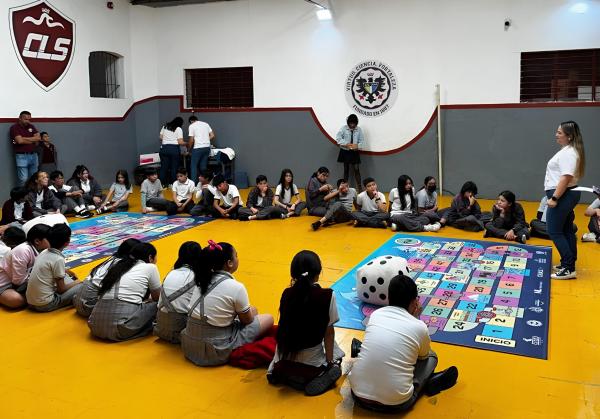
aGuadalajara is based on a methodology grounded in experiences and emotions. The programme recognises that technical information, when not linked to personal experiences, is unlikely to translate into behavioural change. The pedagogical strategy integrates visual resources, participatory dynamics, educational games, and symbolic narratives that allow for the understanding of complex concepts such as scarcity, climate risk, and pollution. This approach is in line with international recommendations on action-oriented environmental education. Emotional learning benefits the attention span, retention of information, and knowledge acquisition, facilitating the translation of technical concepts into everyday practices.
Environmental Education
The workshops address fundamental aspects of water management such as availability of fresh water, natural and urban water cycles and water supply, sanitation and drainage. Furthermore, topics covered include pollution from waste and microplastics, the impact of domestic leakages and practical actions for water savings and efficiency. The relationship between climate change, droughts, and floods and aspects of water management are developed using fun learning tools that reinforce learning through repetition and association, in line with environmental education approaches recommended by UNESCO.
The operational model includes structured workshops with an initial diagnosis of schools and homes, interactive training, fun learning reinforcement, and subsequent evaluation.
The programme incorporates measurement tools that allow for the evaluation of changes in knowledge, perception, and behaviour, both in schools and within the families. This information contributes to the creation of indicators aligned with the Sustainable Development Goals, particularly SDGs 6, 11, 12, and 13.
Education as A Bridge Between Engineering and Public Policies
One of the distinctive elements of the programme is its technical leadership. Developed by civil engineers, aGuadalajara translates concepts specific to hydraulic engineering—efficiency, losses, resilience, and risk—into socially accessible language.
This articulation strengthens the link between physical infrastructure and social infrastructure, recognised by multilateral development banks as a key element for the sustainability of water systems.
Institutional Alliances and International Cooperation
aGuadalajara began with an agreement with the Municipality of Guadalajara, with an approximate addressing target of 183,000 children.A key component for the legitimacy, scalability, and projection of the program has been the close collaboration between the CICEJ and the University of Guadalajara (UdeG). This connection has made it possible to articulate technical and pedagogical capabilities, as well as to strengthen the dialogue with strategic spaces for communication, applied research, and environmental public policies.
Beyond institutional support, this alliance operates as a mechanism for transfer and validation, as it connects the technical expertise of a professional association with the academic and social reach of a leading public university, expanding the program’s capacity to engage in dialogue with national and international actors, build cooperation networks, and open avenues for replicability.
From a governance perspective, this CICEJ-UdeG relationship demonstrates how the alliances between specialised civil society and academia can build institutional infrastructure to sustain long-term environmental education programs, avoiding isolated efforts and promoting continuity, evaluation, and territorial scaling. Thanks to this collaboration, the program has been presented at international forums, such as the 2023 International Habitat Summit of Latin America and the Caribbean, and Hábitat LATAM 2025, where its content was shared with the Funeco Robles Foundation, and our workshops have reached places such as Jamundí, in the Valle del Cauca Department in Colombia.
The programme has also been presented at other specialised international forums, such as Aquatech Mexico City, Aquatech Amsterdam, and Seoul Water, by the Metropolitan Government of Seoul, in a process of projecting significant strength thanks to academic and networking collaborations to bring an initiative born from technical civil society to discussion platforms with a regional and international focus. The programme is part of the commitments included in the United Nations Water Agenda under the number # SDGAction53580, and has received international cooperation, notable from the Ambassador of the Kingdom of the Netherlands to Mexico.
Environmental Education in Public Spaces
During the summer of 2025, AGuadalajara significantly expanded its reach by moving its environmental education workshops to the Museum of Paleontology of Guadalajara, consolidating a key stage of expansion beyond the traditional school and educational environment. This experience allowed the program’s methodology to be integrated into a scientific outreach space open to the public, facilitating children to environmental knowledge from a playful, interactive, and culturally accessible perspective. The high participation of scout groups, as well as families and museum visitors, demonstrated the social interest in this kind of initiative, and confirmed the adaptability of the educational model to unconventional contexts, without losing technical rigor or pedagogical clarity.
In addition, aGuadalajara maintains ongoing activities throughout the year in shelters and care homes for vulnerable children, reinforcing its social mission and inclusive approach. The program also participates regularly in children’s science fairs organised by the Universidad de Guadalajara, strengthening the cooperation between academia and civil society, and expanding its territorial coverage. These actions have positioned the programme as a flexible environmental education platform, capable of integrating into both cultural and community spaces, and consolidating a continuous educational strategy that transcends school and instructional boundaries.
Towards Permanence and State-wide Coverage
The programme is currently undergoing a process of consolidation through a collaboration agreement with the Government of the State of Jalisco, with the aim of establishing a permanent strategy for children’s environmental education with a state-wide coverage. This phase responds to the conscience that water challenges transcend municipal boundaries and require institutional continuity, as an effort to contribute from civil society to raise awareness and sensitise people to the reality we live in regarding water management and environmental care, placing in the center of our actions the premise that no economic resource will be sufficient for water infrastructure if we do not change our way of thinking and acting.
Education as Social Infrastructure for Water Security
aGuadalajara demonstrates that environmental education is not an accessory component, but rather an essential element of ‘social infrastructure’ for water governance. Future resilience will depend as much on the quality of water infrastructure as on the raising of an informed and co-responsible society. Water security is not only something that is designed and built; it is also learned.
Source: https://tinyurl.com/576h7tbk